Classical Indian Dance
Classical Indian dance, in particularly Bharatanatyam and Odissi, as Balasaraswati puts it, is an artistic yoga (natya yoga), for revealing the spiritual through the corporeal. Bharatanatyam is the most widely practised of Indian classical dances worldwide, as it is the style that most faithfully adheres to the Bible of the classical Indian dance, the Natya Shastra, and most comrehensively embodies it. It is also the most ancient of all the classical dance forms in India. 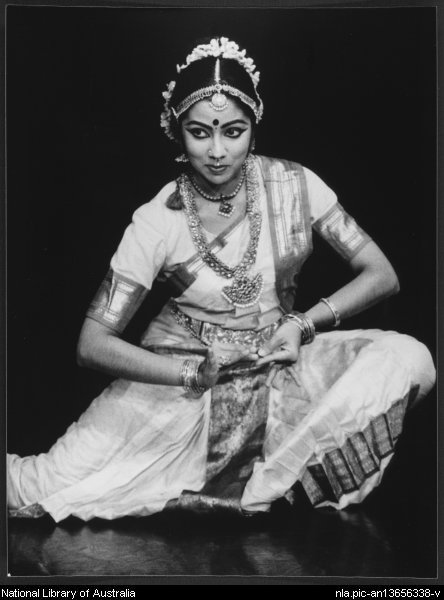
|
|
Art is collaboration between God and Man, raising him to the exclusive band of creators and taking him deeply within and around his hard work. It is a unique result of a unique temperament with its beauty derived from mutable disconcert of his environment. When early man stenciled an impression of the dark of wall of the cave, he was deliberately, vision and creation.
This story of art has been largely the story of man?s continuing search of meaningful marks for shape, movement and image that can most eloquently express his experience of the inner and outer world, resulting in enlargement and perpetuation. Such a man, bestowed with reason, had always been a grater thinker, when absorbed in his surroundings he was pondering, imaging and visualizing the shape of things to come about the domestic carvings and comforts in life.
Creation motivated by different desires resulted knowingly or unknowingly in chronicling his present for the future and preserving them for posterity.
These instincts found their vent in different forms and in fact they were the foundation of the birth of fine arts. Born thus, the arts improved from stage to stage and from age to age in different forms and styles, from the initial crude lines to the superfine form and movement. In ancient India, fine arts of dance, painting and sculpture were developed and inspired by religion. All arts like all stages of life and embodied in religion. Indian art is life suffixed by religion and philosophy. Art was dedicated to providing objects of worship in a life ordered by faith. Indian art of all the periods has been close to life both divine and traditional.
The theory of Indian dance cannot be isolated from the arts of literature, sculpture, painting and music. Human nature with its joy and sorrow is depicted by means of representation through dance.
Dance is the rhythmic physical movement prompted by feelings and emotions from the cavemen through the growth of civilization. Beins the supreme art, its scope as explained by Bharata in its Natya sastra embraces all themes of life.
Indian dance takes human figure as its basic instrumental of expression and its synthesis at the technique of other arts becoming the most beautiful and significant approach of the Hindu mind. Dance has a message for its audience that exhorts to live the deal life in the path of righteousness, prosperity and fame.
There are dance traditions of India, of different regions and at different levels of society, each dance tradition has to be clearly identified both in terms of the evolution of artistic form and style in time, and its socio-cultural pattern within the dance traditions flourished is a highly abstract approach on one level and a preoccupation with multiple symbolic form on the other.
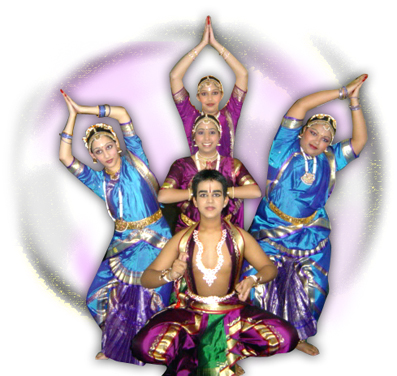
In India tribal, folk, and classical dance are continually merging into each other, inter acting and in many moments of historical time co-exist. There are dance traditions that are prevalent in different parts of India. Each region has its distinctive forms that can be further subdivided into three broad levels of the tribal folk and classical dances. While the first two terms suggest a socio-economic stratification, the last indicates the degree of stylization in form rather than a socio-economic level. The classical dance styles of all regions in India share certain common fundamentals of a technique. Today about five dances namely Bharatanatyam. Kathakali, Orissi,Manipuri and Kathak are recognized as classical, to these could be added others which falls into the category of traditional dance drama forms such as kuchipudi form Andhra Pradesh, yakshagana from Mysore, and Kudiattam of Kerala.
The oral tradition provides the constant vehicle of communication and mobility within groups and regions: a common body of myth- legend literature unites the three levels and cuts across normal insular socio-economic stratification between classical and folk, urban and village elicits and popular. |
Contact us :
H.No. 422/16, Buta Singh Colony,
Meera Ghati, Karnal - 132001
Haryana, India
Cell : +91-93151-64106 | 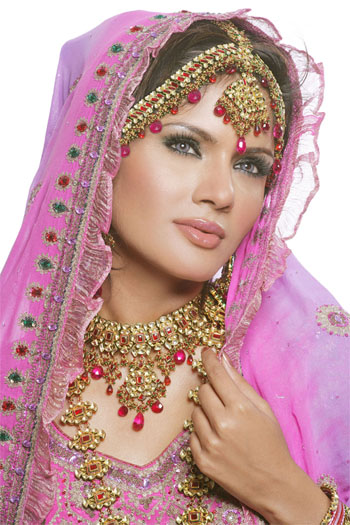
A Look on Indian Clothing
Sarees
A sari is a wide strip of fabric that is several yards long, and draped around the body with pallu on the shoulder depending on the wearer's location, social status, and preference. Under the saree, women wear a pavada (a long, close-fitting skirt) and a choli, often in coordinating fabric. Sarees are traditionally made of lightweight silk, although modern versions are sometimes being produced from cotton blends. Sarees are unsually richly dyed and decorated. Often, a wide border runs the whole length of the saree, traditionally in raised gold fabic.
Salwar kameez and dupatta
The salwar kameez is another form of popular dress for females. It consists of loose trousers (the salwar) topped by a long loose shirt (the kameez). It originates from the Muslim invaders from Turkey and Afghanistan. For a long time it was considered a "Muslim dress" but now has become popular all across India, as well as other South Asian countries. Due to its Muslim origin, it is very common in Pakistan and Afganistan. It is commonly worn with a narrow scarf called a dupatta, which is used to cover the head. The salwar kameez is most common in the northwestern part of India.
Lehenga, choli, and odhani
The women of Rajasthan and Gujarat often wear colorful swirling skirts called lehenga, paired with a short bodice called a choli. If they must cover their heads, they do so with bright veils called odhani.
Tribal Styles
Tribal styles vary greatly, but usually correspond with the same styles as salwaar kameez, choli, and other Indian dress. These uniforms are often rich in colour
Men's clothing
The most common male attire consists of the dhoti and kurta, worn in most of the western and central regions. A sherwani is typically worn for special occasions. Men of northern India and the Punjab may also wear salwar kameez, often in plain white cotton, and top the kameez with a dark waistcoat. The lungi (a type of wrap-around garment) is worn in many parts of India, but depending on the social practices of the region it may be restricted to indoor-wear only
Sun Worship in India
Abodes of Surya
Beliefs and Legends >> Surya
The Vedic scriptures of the Hindu religion refer to the sun as the store house of inexhaustible power and radiance. Ths sun god is referred to as Surya or Aditya. The Vedas are full of hymns describing the celestial body as the source and sustainer of all life on earth. The origin of the worship of the Sun in India is thus several centuries old.
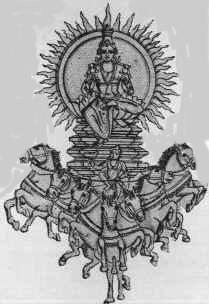
References to sun worship are found in the puranas. The Ramayana speaks of Sage Agastya initiating Rama into sun worship through the Aditya Hridaya Mantra. The astronomer and astrologer Varahamirhira makes references to the intricacies of ceremonies connected with the installation of the icon of the Sun. Mayura, who lived in the court of Harshavardhana (1st millennium CE) composed the Surya Satakam in praise of Surya and is believed to have been cured of blindness.
It is also said that Iran was once a center of Solar worship and that some of the Magha priests of Iran had been brought to India to officiate in ceremonies.
Sun temples in ancient days were known as Aditya Grihas. The traveller Ktesias mentions a site of sun worship in western India (400BC).
Sun temples across the subcontinent absorb the flavor of the region that they belong to. Dakshinaarka Temple in the Gangetic Plains (considered to be a site for making offerings to ancestors), Suryanaar Koyil in South India , Arasavilli and Konark on the East Coast of India, Modhera in Gujarat (Western India), Surya Pahar in North Eastern India and Unao in Central India are some of the well known sun temples of India.
It should be mentioned here that remains of an ancient Sun temple are found at Martanda near Srinagar in Kashmir. It is said to date back to the first century CE. Ruins of a sun temple which attracted thousands of visitors in the 7th century CE are found in Multan in Pakistan.
Several temples dedicated to Shiva, feature a small shrine for Surya the Sun God. In addition, it is believed that Surya, the Sun God has offered worship at several of the shrines in Tamilnadu; many of these shrines have been designed in such a way that the sun's rays illuminate the sanctum (of Shiva) on certain days of the year. Several of the South Indian Temple Tanks also bear the name Surya Theertham or Surya Pushkarini.
|